


3 September 2026
The State and the Government are taking advantage of the holiday period to launch a number of public consultations and approve the Renewable Energy Acceleration Programme

In June, July and August alone, Palombar – Nature and Rural Heritage Conservation took part in eight public consultations launched during that period and which were mainly active in July and August: five on private energy projects in the Northern region, Palombar’s main area of operation; two on national strategy plans; and one public consultation at European level on the two main European directives on the conservation of biodiversity and ecosystems, the Birds and Habitats Directives. In most cases, these are projects that would have a significant negative impact on the local area and society if they were to proceed unchanged.
.png)
The energy transition must not be carried out at the expense of biodiversity and the quality of life of local communities.
If the transition is not implemented effectively and in a way that benefits those it is intended to serve – society and nature – we run the risk that, instead of building a better future for everyone and for our shared ‘home’, we will destroy what we have collectively managed to (re)build and protect over decades.
PALOMBAR SUBMITTED COMMENTS IN THE EIGHT PUBLIC CONSULTATIONS
But we haven’t been on holiday. We are keeping a close eye on developments and taking action. Over the past three months, Palombar has actively contributed by submitting comments in these eight public consultations on projects to be implemented in the North region or across the country. These are projects based on strategies that mobilise significant resources over a long period, which would have a negative impact on the landscape, biodiversity and local communities if they were to proceed as proposed by their promoters (including the State itself), and which therefore require public awareness and immediate joint and collective action.
Sectoral Programme for Renewable Energy Acceleration Zones approved without a concluded public consultation
The controversial and questionable Sectoral Programme for Renewable Energy Acceleration Zones (PSZAER) was approved by the Government on 20 August. Palombar issued a statement in which it categorically disagrees with this Programme on the grounds that it fails to meet essential requirements for ensuring an environmentally effective and socially just energy transition.
.png)
Palombar disagrees with the PSZAER as presented in the Public Consultation.
Following the recent approval of the PSZAER, we are now analysing the responses to the submissions made during the Public Consultation on this Programme, which, perplexingly, has not yet been marked as ‘Closed’ on the Participa portal, despite the Programme having already been approved. This means that the 8,375 submissions made remain with the status ‘Under review’, and therefore did not carry the social weight that might reasonably be expected, nor were they taken into account in the final decision, revealing the sham nature of this supposedly participatory process. Furthermore, we are assessing the documents now made available on the platform in order to take an updated position on this fundamental matter shortly.
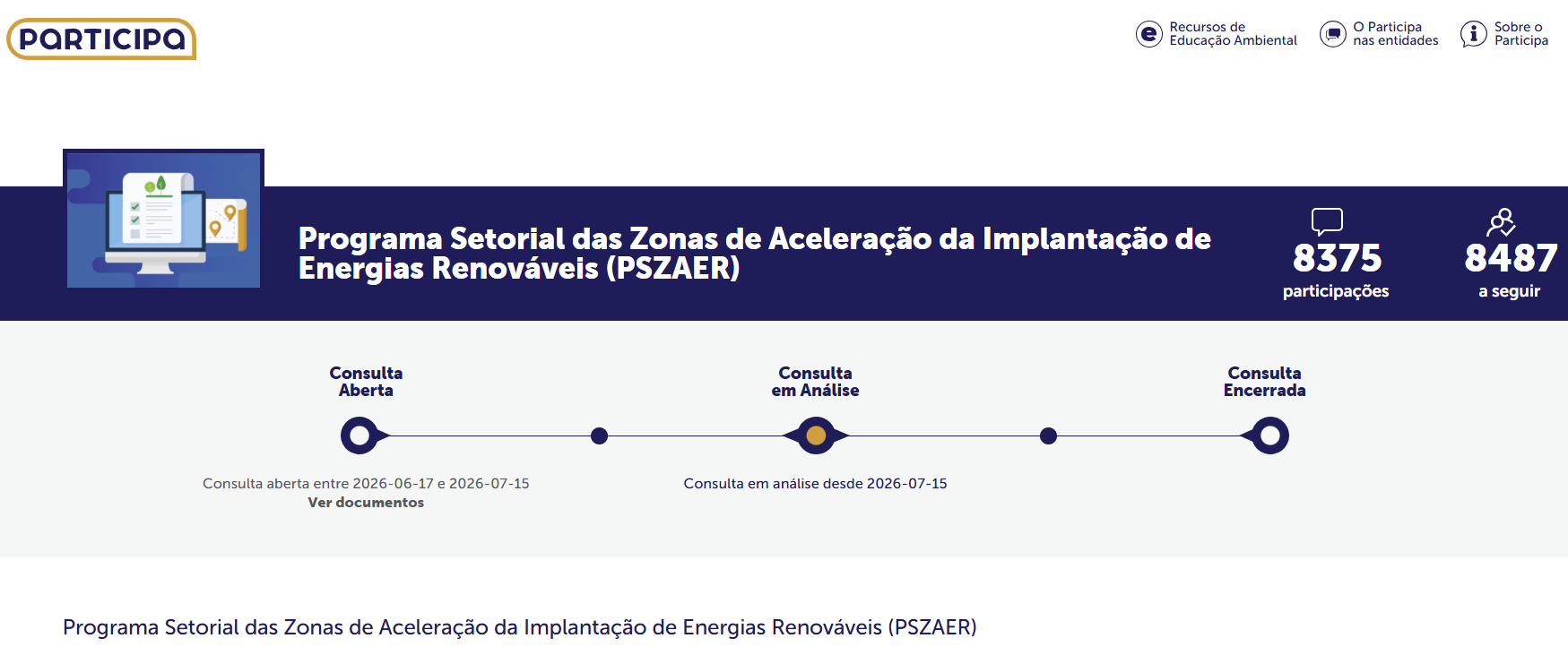
Screenshot taken on 3 September 2026, at 10.51 am, of the page dedicated to this Public Consultation on the Participa platform’s website.
From the extensive document we have drawn up, we highlight our main concerns and recommendations. With regard to the proposed Programme, which has been put out for Public Consultation, we consider the following to be essential:
1. The provision of complete cartography, that is, the georeferenced data to be used by the Programme; 2. Should there be a second public consultation, to extend the deadline for submitting contributions, given the volume of documents to be analysed and the technical complexity of the content; 3. To provide a quantitative basis for the energy requirements necessary for the country’s decarbonisation, in order to avoid an unnecessary surplus of renewable energy projects; 4. To prioritise built-up areas and similar sites, as well as decentralised generation, before altering land uses and the associated occupation of forest, agricultural, and land adjacent to protected areas and residential zones; 5. Streamline and simplify the criteria for decentralised generation and energy communities; 6. Promote the installation of solar panels in ‘non-places’, that is, in transitional spaces which, by virtue of their characteristics, do not affect human well-being or biodiversity, in already developed areas close to centres of consumption; 7. Opt for the most conservative scenario regarding exclusion criteria.
Furthermore: 8. Ensure the identification and subsequent exclusion of ZAERs in areas with potential for ecological restoration; 9. Include scenarios for the negative effects of climate change on the displacement of biodiversity within the context of refugia; 10. Increase safety distances from residential areas (settlements) and nature conservation areas to protect against negative impacts on public health and habitats; 11. Identify cumulative impacts with existing and potential projects in areas outside ZAERs; 12. Prohibit the extension of projects into contiguous areas, ensuring minimum distances are sufficiently large to prevent the accumulation of effects from projects of this type; 13. Define and limit a maximum percentage of ZAERs (and associated projects) per municipality.
Finally: 14. Ensure that minimum area thresholds are adjusted, given that a range from 100 to over 1,000 hectares is significant enough to bypass environmental assessment procedures; 15. Increase the technical capacity of local authorities; 16. Address local benefits by ensuring they are directly recognised by communities in the surrounding areas; 17. Put in place safeguards for consumers, ensuring lower electricity costs and grid security, as well as the continued involvement of local authorities in defending their rights and heritage; and 18. Actively plan for grid requirements so that this factor does not constrain land use.
Project for the National Nature Restoration Plan and its strategic environmental assessment
Together with eight national environmental non-governmental organisations, Palombar took part in this public consultation and put forward a set of proposals and recommendations regarding this Plan, highlighting as its main concern the disconnect between the assessment of the current situation in this area and the implementation of nature restoration measures.
(1).png)
The project for the National Nature Restoration Plan has already been submitted to the European Commission.
EC PUTS BIRD AND HABITATS DIRECTIVES TO THE TEST IN A PUBLIC CONSULTATION THAT CLOSED IN AUGUST
Public consultation to assess the costs and benefits of implementing the European Union’s Birds and Habitats Directives
At European level, we also contributed to a public consultation launched by the European Commission (EC), which closed on 10 August. The aim was to gauge public opinion on whether the benefits provided by the European Union’s Birds and Habitats Directives – the main legal instruments for the protection of biodiversity and ecosystems in Europe – justify the administrative and financial costs allocated to their implementation on the ground.
In our submission, we stated that the Birds and Habitats Directives have already amply demonstrated their value, remaining scientifically sound, economically justified and widely supported. We emphasised that the evidence shows that Europe’s biodiversity declines more slowly and recovers more successfully where the Directives are fully implemented.
We emphasised, in no uncertain terms, that the future success of the two Directives depends less on changing their objectives than on providing the resources, governance structures and political commitment needed to achieve them.
By addressing the shortcomings in the implementation of the directives, rather than emphasising administrative procedures as an intrinsic obstacle, we believe that the initial effort may yield greater benefits in the long term.
.png)
The Birds and Habitats Directives are the main legal instruments for the protection of biodiversity and ecosystems in Europe.
THE PROJECTS THAT (ALMOST) NO ONE TALKS ABOUT BUT WHICH AFFECT US ALL
Proposed Scope Definition (PDA) for the Planalto Branco Solar Photovoltaic Power Station Project (Hybridisation of the Baixo Sabor Hydroelectric Power Station)
Regarding this Scope Definition Proposal, Palombar has submitted a response in which it disagrees with and rejects the overall robustness envisaged in the Environmental Impact Assessment’s Scope Definition Proposal concerning the assessment of the environmental impacts likely to result from the installation and operation of the solar photovoltaic power station. The Planalto Branco Solar Photovoltaic Power Station reduces the availability of habitats and ecological connectivity, whilst, at the same time, the Very High Voltage Transmission Line increases the risks of collision and mortality for birdlife, as well as irreversibly altering the landscape of the area.
Furthermore, we considered that the proposal fails to adequately address the legal framework applicable to sensitive areas and the natural values present in the site and its surroundings, fails to adequately demonstrate how the objectives of renewable energy production and biodiversity conservation can be reconciled, underestimates the potential impacts on current land uses and on local socio-economic development, and does not unequivocally clarify the specific benefits that the developer undertakes to ensure for the affected populations and communities.
In renewable energy hybridisation projects – the combination of two or more renewable energy sources (such as solar and wind power) that share the same connection to the electricity grid and the same infrastructure – the ends do not justify the means, particularly when the means destroy ecosystems and harm local and regional communities.
.png)
Hybridisation combines two or more sources of renewable energy, such as solar and wind, or solar and hydroelectric.
Scope Definition Proposal (SDP) for the Fronteira Wind Farm Project (Hybridisation of the Picote Hydroelectric Power Station)
Palombar disagreed with and rejected the general approach set out in this project’s PDA on the grounds that it is highly likely to cause significant negative environmental and social impacts. Furthermore, it considers that the proposal gives inadequate and marginal consideration to the legal framework applicable to sensitive areas and the natural assets present in the affected zone; fails to align decarbonisation objectives with nature conservation; underestimates the region’s socio-economic potential; and does not unequivocally clarify the local benefits that the developer undertakes to ensure.
Proposed Scope Definition (PDA) for the Penedo Solar Photovoltaic Power Station Project (Hybridisation of the Foz Tua Hydroelectric Power Station)
Palombar has opposed this project on the grounds that it is likely to cause significant negative impacts in terms of the protection and conservation of the Iberian wolf. It has therefore rejected the implementation of the project at the proposed site, as it jeopardises the stability of the Trancoso pack and the viability of the species’ Southern Douro population.
.png)
The red kite is one of the threatened bird species that may be affected by renewable energy hybridisation projects in the north-east of Trás-os-Montes.
Scope Definition Proposal (PDA) for the Cereiro Solar Photovoltaic Power Station Project (Hybridisation of the Bemposta Hydroelectric Power Station)
In its submission regarding this project, Palombar warned of negative impacts on threatened species such as the Montagu’s harrier (Circus pygargus), the red kite (Milvus milvus) and the Iberian wolf (Canis lupus signatus), amongst others. Similarly, it disagreed with and rejected the overall robustness envisaged in the project’s Environmental Impact Assessment (EIA) regarding the assessment of environmental impacts likely to cause significant adverse effects, the project’s isolated treatment within the region, the underestimation of regional socio-economic potential, and the lack of clarity regarding the local benefits to be delivered by the developer.
Boticas Bypass and Connection to the A24
As part of the public consultation on this project, Palombar issued warnings and recommendations aimed at protecting the Iberian wolf (Canis lupus signatus), preventing ecological fragmentation and ensuring the conservation of water and geomorphological resources, with a view to safeguarding the environmental resources and economic activities linked to the region’s agro-silvo-pastoral sector.
ENVIRONMENTAL EDUCATION, NATURAL PARK BOUNDARIES AND ANOTHER PHOTOVOLTAIC HYBRIDISATION PROJECT
Even before the summer holidays (June, July and August), Palombar had already taken part in three other equally important public consultations:
National Strategy for Environmental Education 2030
With regard to this public consultation, Palombar acknowledged the overarching vision of the National Environmental Education Strategy 2030 to enhance environmental literacy and foster society’s active involvement in nature conservation. However, it warned that the lack of a consolidated operational plan for each measure within the current timeframe of the national strategy could limit the efficiency of the investment made and, as a result, fail to produce the expected outcomes. We therefore highlighted the need to review the development roadmaps for each measure, in order to ensure their effective implementation on the ground, along with their mechanisms, monitoring and reporting.
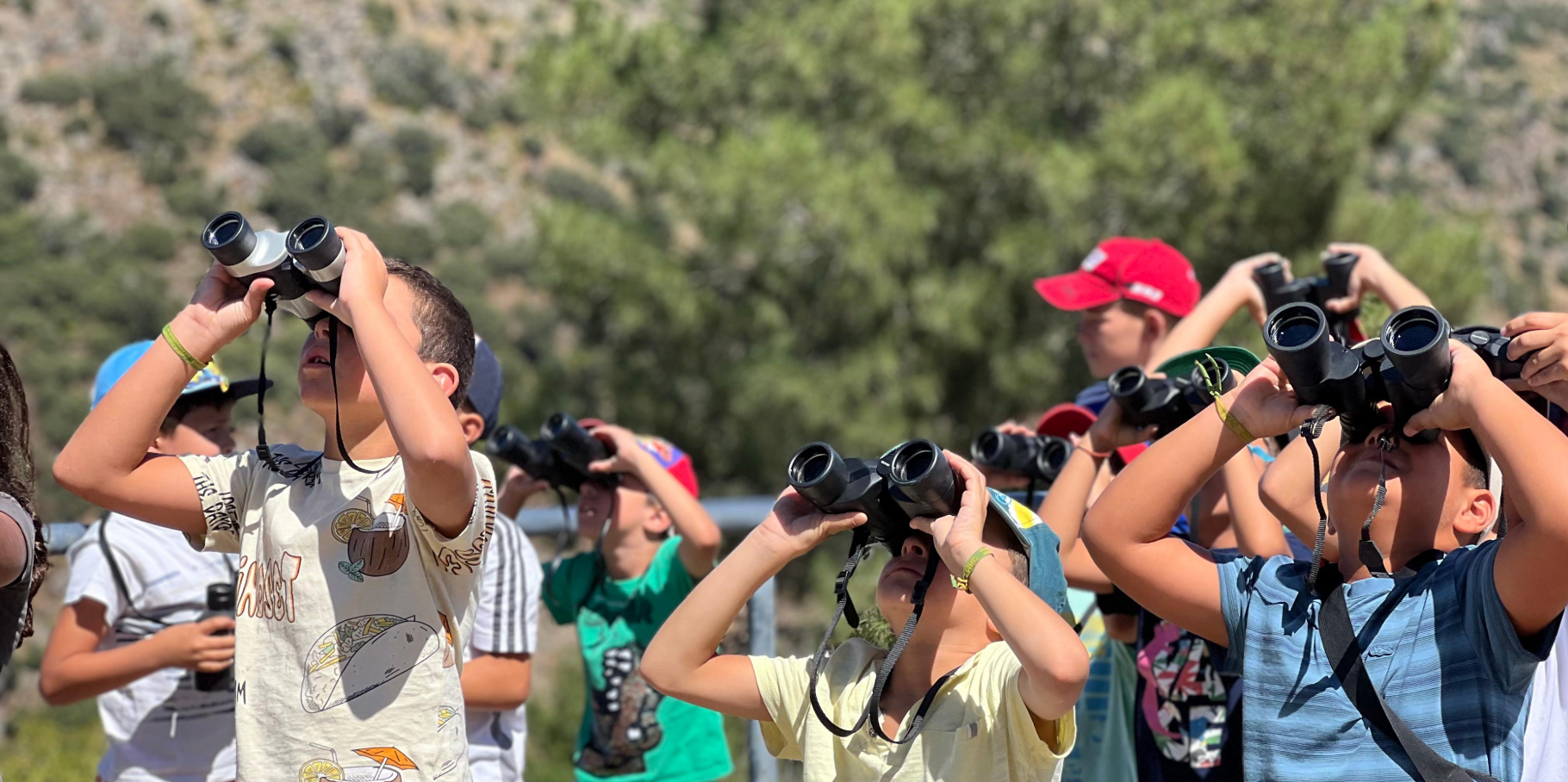
The National Strategy for Environmental Education must ensure the effective implementation of measures on the ground.
Updating the boundaries of the Montesinho, Douro Internacional and Alvão nature reserves
With regard to this public consultation, through the LIFE Aegypius Return project consortium, Palombar viewed the cartographic update of the nature reserves’ boundaries as an opportunity to improve the accuracy and consistency of the digital representation. However, it pointed out that the information made available as part of the Public Consultation did not allow for a detailed technical analysis, in particular due to the lack of interoperable formats, such as shapefiles or similar. This recurring limitation not only hinders the technical work of cross-referencing spatial data relevant to project impact assessments and the definition of mitigation measures, amongst other things, but also, in countless circumstances, prevents the accurate assessment of land-use layers, which results in inefficiencies in both assessment and operational processes.
.png)
The information made available as part of this Public Consultation did not allow for a detailed technical analysis to assess the potential impacts on endangered species such as the cinereous vulture.
The project consortium therefore proposed that the updated boundaries be made available in an accessible georeferenced format, along with the associated methodological information, and, most importantly, that this suggestion be incorporated into the standard procedures for public consultations involving territorial demarcations.
Participation is only truly informed and useful when there is access to the most up-to-date and accessible data, particularly for bodies with technical and scientific responsibility. We therefore recommended that the updates be made available in interoperable formats.
Penedo Ruivo Wind Farm Photovoltaic Hybridisation Project
Regarding this project, Palombar opposed the implementation of a photovoltaic solar power station in the proposed area. We stated that it was equally essential to carry out a regional assessment of the cumulative effect of renewable energy generation projects in environmentally and socially sensitive areas.
.png)
The transition to renewable energy must benefit nature and human communities, and not be implemented at their expense.
GREEN ENERGY: WHERE, HOW AND FOR WHOSE BENEFIT?
It is not enough simply to have infrastructure across the country producing green energy from wind, sunlight or other renewable sources. Just as essential as this is the need to ask questions and have clear answers: where is it being produced (and, more importantly, what is being destroyed in order to produce it)? And who is benefiting from this production? If the answer always points in one direction – towards large corporate groups, to the detriment of the communities and nature that are supposedly being protected and benefiting – then we are undoubtedly not on the right track. Renewable energy, yes, but not like this.