


22 July 2026
Cereal trials: with the field harvested, the LIFE SOS Pygargus project moves on to analysing the harvest results
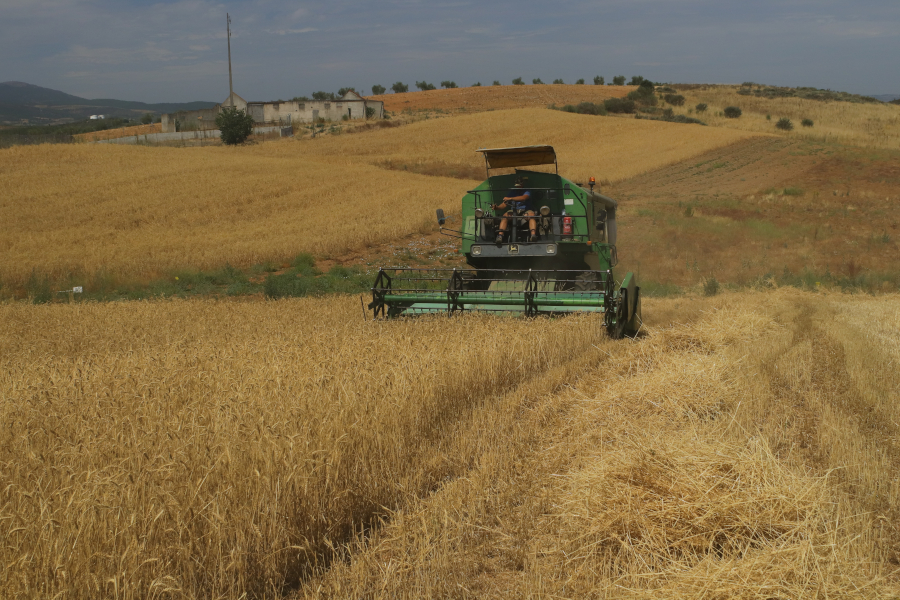
The harvest marks a crucial stage in the trials. Photo: Joaquim Teodósio/Palombar.
The fields cultivated with the cereal varieties being tested as part of the LIFE SOS Pygargus project were harvested on 14 and 15 July at Quinta do Valongo, which belongs to the Mirandela Innovation Centre of the Northern Regional Coordination and Development Commission (CCDR-Norte), in Trás-os-Montes. The next step is to analyse the results of this year’s harvests, with a view to identifying the best varieties that ensure agricultural practices which are better adapted, more sustainable and more favourable to the Montagu's harrier and all the biodiversity that sustains its habitat.
Sowing in autumn, harvesting in summer
Sowing took place at Quinta do Valongo in late November 2025, during the autumn, and the harvest took place this summer, in mid-July. In the field, the crops of the 20 varieties of the five cereals under trial (soft wheat, barbela wheat, rye, oat and triticale) were continuously monitored by researchers from INIAV – the National Institute for Agricultural and Veterinary Research – as well as by technicians from CCDR-NORTE and ANPOC – the National Association of Protein, Oilseed and Cereal Producers, project partners responsible for conducting the cereal trials. The crops were assessed in the field at all stages, from seedling emergence through to grain filling.
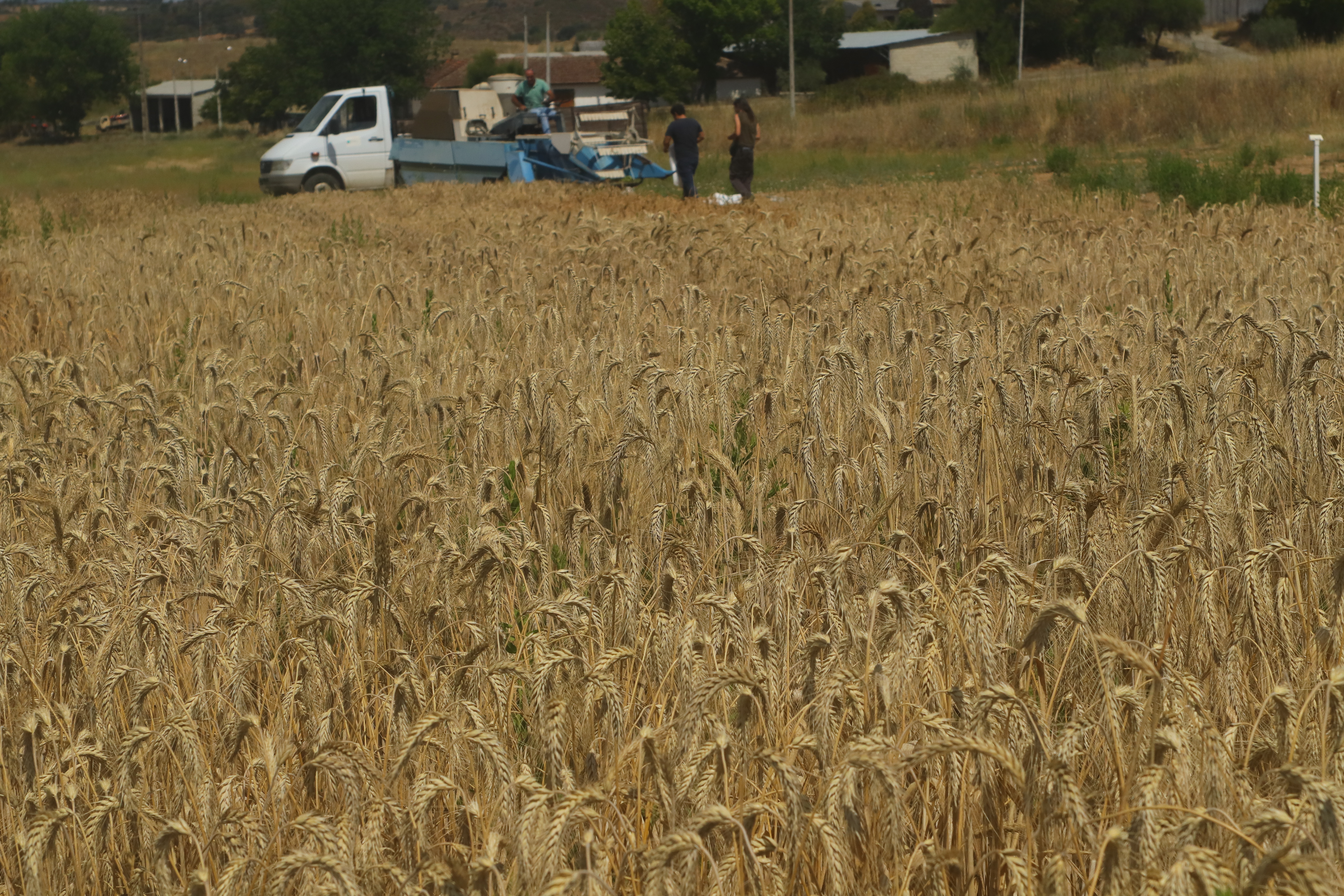
Harvest marks a crucial stage
The cereal harvest marks a crucial stage in the trials, as it enables data to be collected on the behaviour of the different varieties and their potential to be assessed, taking into account the project’s objectives, under real field conditions. The next stage is the analysis and evaluation of the results obtained this year in the field.
Cereals that are friendly to the Montagu’s harrier
The cereal trials have a very specific purpose: to select the varieties with the longest growing season that are best adapted to the breeding cycle of the Montagu’s harrier (Circus pygargus). Late harvesting reduces mortality and increases the breeding success of this species and other steppe birds that nest on the ground in agricultural fields.

The varieties must also meet other essential requirements, such as being better adapted to the northern region and having greater resistance to climate change, as well as to the main diseases and pests.
Through this project, we are bringing together farmers, scientists and conservationists to boost national cereal production and protect the biodiversity of the agricultural landscapes that sustain us.
The collective strength of a collaborative project
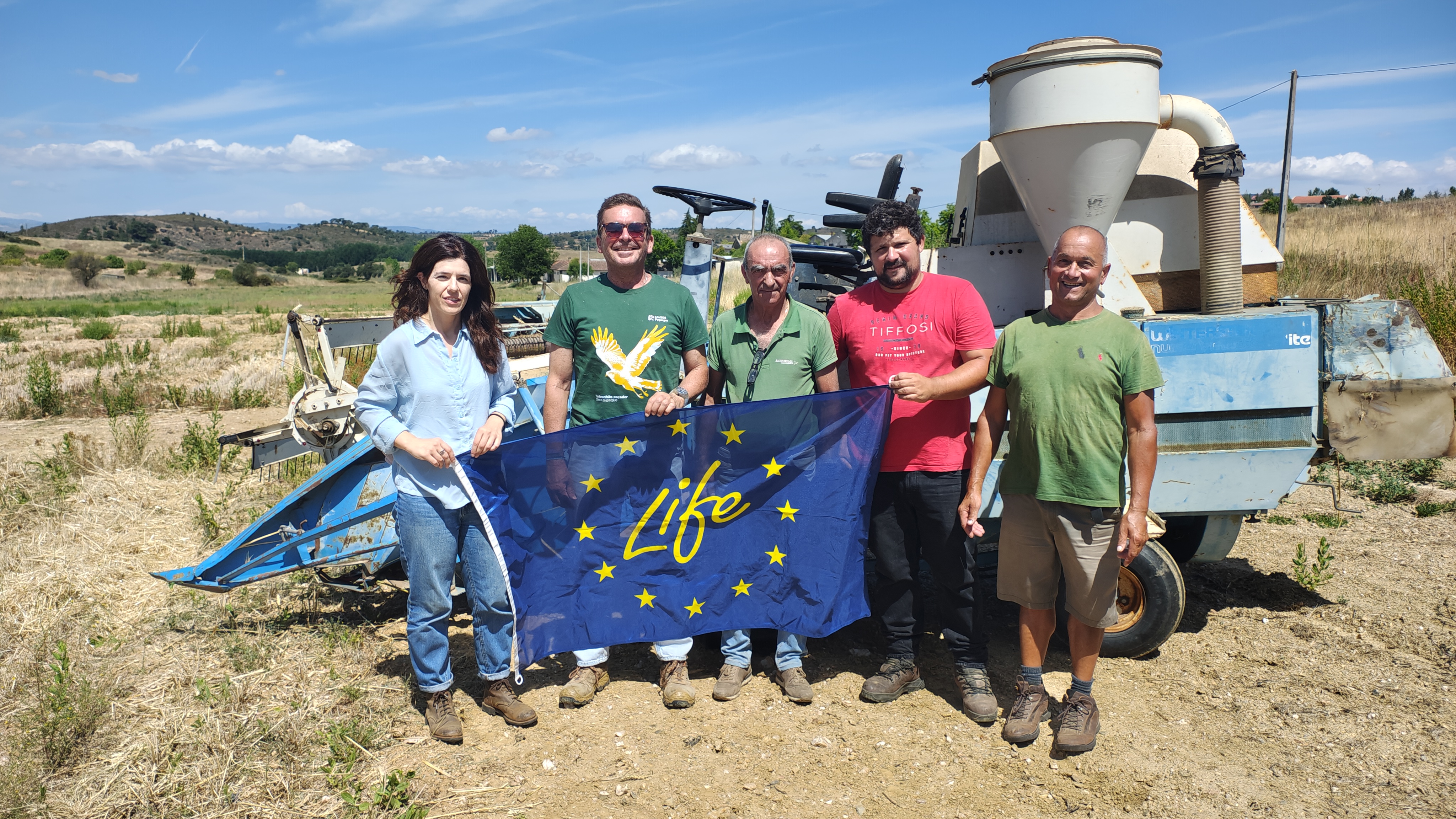
The harvest carried out in the fields at Quinta do Valongo benefited from the vital collaboration of the CCDR-Norte team, notably the experienced agricultural machinery operators, as well as technicians from INIAV, Palombar – Nature Conservation and Rural Heritage, and AEPGA – Association for the Study and Protection of Donkeys. In this project, we have brought together a collective force where the whole is greater than the sum of its parts. We would like to thank everyone for their tremendous joint effort, which was essential to the success of the harvests.
LIFE SOS Pygargus – Urgent conservation actions for Montagu’s harrier populations in Portugal and Spain is an Iberian project co-funded at 75% by the European Union’s LIFE Programme. It also receives co-funding from Viridia – Conservation in Action, Lightsource bp, the Portuguese Environmental Fund, and the Biodiversity Foundation of the Spanish Ministry for Ecological Transition and Demographic Challenge.
It is implemented by a consortium that includes Palombar – Nature and Rural Heritage Conservation (coordinating entity), BIOPOLIS-CIBIO Association, AEPGA – Association for the Study and Protection of Donkeys, ANPOC – National Association of Protein, Oilseed and Cereal Producers, CCDR-N – North Regional Coordination and Development Commission, EDIA – Alqueva Development and Infrastructure Company SA, ICNF – Institute for Nature Conservation and Forests, INIAV – National Institute for Agricultural and Veterinary Research, LPN – Nature Protection League, MC Shared Services SA, Modelo Continente Hipermercados SA, SPEA – Portuguese Society for the Study of Birds, UTAD – University of Trás-os-Montes and Alto Douro, Vita Nativa – Environmental Conservation, AMUS – Action for Wild World, the Department of Agriculture, Livestock and Sustainable Development of the Regional Government of Extremadura, GREFA – Group for the Rehabilitation of Native Fauna and its Habitat, and the University of Murcia.
Sowing in autumn, harvesting in summer
Sowing took place at Quinta do Valongo in late November 2025, during the autumn, and the harvest took place this summer, in mid-July. In the field, the crops of the 20 varieties of the five cereals under trial (soft wheat, barbela wheat, rye, oat and triticale) were continuously monitored by researchers from INIAV – the National Institute for Agricultural and Veterinary Research – as well as by technicians from CCDR-NORTE and ANPOC – the National Association of Protein, Oilseed and Cereal Producers, project partners responsible for conducting the cereal trials. The crops were assessed in the field at all stages, from seedling emergence through to grain filling.
Cereal trials are carried out by the project partners INIAV, CCDR-Norte and ANPOC. Photo: Joaquim Teodósio/Palombar.
Harvest marks a crucial stage
The cereal harvest marks a crucial stage in the trials, as it enables data to be collected on the behaviour of the different varieties and their potential to be assessed, taking into account the project’s objectives, under real field conditions. The next stage is the analysis and evaluation of the results obtained this year in the field.
Cereals that are friendly to the Montagu’s harrier
The cereal trials have a very specific purpose: to select the varieties with the longest growing season that are best adapted to the breeding cycle of the Montagu’s harrier (Circus pygargus). Late harvesting reduces mortality and increases the breeding success of this species and other steppe birds that nest on the ground in agricultural fields.
Varieties with a longer growing cycle are essential for increasing the breeding success of the Montagu’s harrier. Photo: Joaquim Teodósio/Palombar.
The varieties must also meet other essential requirements, such as being better adapted to the northern region and having greater resistance to climate change, as well as to the main diseases and pests.
Through this project, we are bringing together farmers, scientists and conservationists to boost national cereal production and protect the biodiversity of the agricultural landscapes that sustain us.
The collective strength of a collaborative project
The harvest carried out in the fields at Quinta do Valongo benefited from the vital collaboration of the CCDR-Norte team, notably the experienced agricultural machinery operators, as well as technicians from INIAV, Palombar – Nature Conservation and Rural Heritage, and AEPGA – Association for the Study and Protection of Donkeys. In this project, we have brought together a collective force where the whole is greater than the sum of its parts. We would like to thank everyone for their tremendous joint effort, which was essential to the success of the harvests.
Experienced agricultural machinery operators from CCDR-Norte played a vital role in the harvest. Photo: Joaquim Teodósio/Palombar.
About the project
LIFE SOS Pygargus – Urgent conservation actions for Montagu’s harrier populations in Portugal and Spain is an Iberian project co-funded at 75% by the European Union’s LIFE Programme. It also receives co-funding from Viridia – Conservation in Action, Lightsource bp, the Portuguese Environmental Fund, and the Biodiversity Foundation of the Spanish Ministry for Ecological Transition and Demographic Challenge.
It is implemented by a consortium that includes Palombar – Nature and Rural Heritage Conservation (coordinating entity), BIOPOLIS-CIBIO Association, AEPGA – Association for the Study and Protection of Donkeys, ANPOC – National Association of Protein, Oilseed and Cereal Producers, CCDR-N – North Regional Coordination and Development Commission, EDIA – Alqueva Development and Infrastructure Company SA, ICNF – Institute for Nature Conservation and Forests, INIAV – National Institute for Agricultural and Veterinary Research, LPN – Nature Protection League, MC Shared Services SA, Modelo Continente Hipermercados SA, SPEA – Portuguese Society for the Study of Birds, UTAD – University of Trás-os-Montes and Alto Douro, Vita Nativa – Environmental Conservation, AMUS – Action for Wild World, the Department of Agriculture, Livestock and Sustainable Development of the Regional Government of Extremadura, GREFA – Group for the Rehabilitation of Native Fauna and its Habitat, and the University of Murcia.