


21 May 2026
Palombar contributed to the Little Bustard National Survey 2026
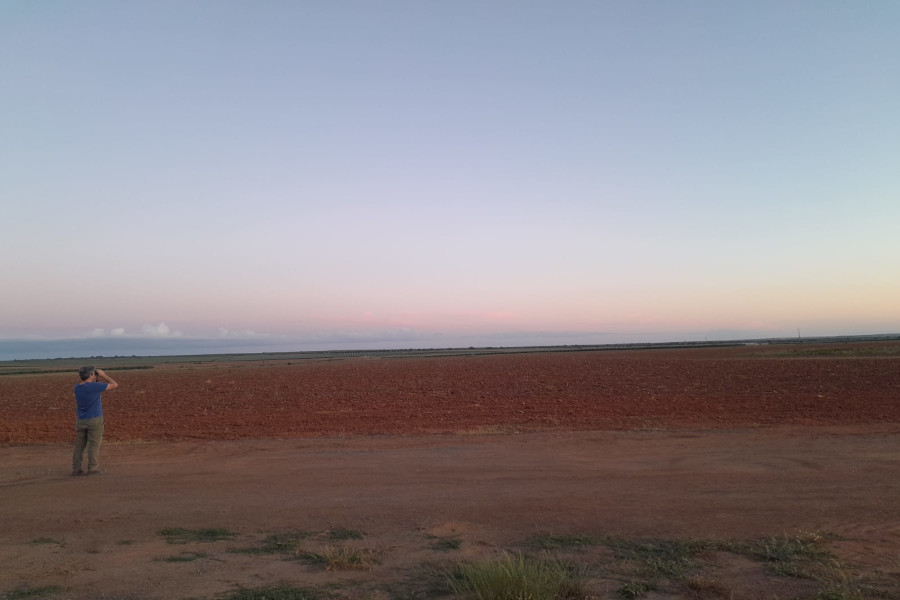
Survey work was carried out in a grid area in the Alentejo. Photo: Helena Raposeira/Palombar.
Palombar is contributing this year, for the first time, to the Little Bustard National Survey 2026, by surveying a grid in Beja, region of Alentejo. This Survey is coordinated by BIOPOLIS - CIBIO at the University of Porto and by Steppe Birds Move, a research group at BIOPOLIS - CIBIO that carries out ecological studies on steppe birds threatened with extinction in the Iberian Peninsula, such as the little bustard (Tetrax tetrax), which has a ‘Critically Endangered’ conservation status in Portugal.
The 25 km² grid in question was surveyed by biologists Pedro Horta and Helena Raposeira from the Palombar research group. Within this area, all sites with steppe habitats were selected. At the time of preparing the study, there were around 3.5 km² of potential areas – of which 35% had recently been converted to permanent crops – leaving just 2.27 km² of available habitat across the entire area.
.jpeg)
Only one individual recorded in the surveyed area
The survey results are in line with the trend observed by the other teams in the field: only a single individual was detected, outside the grid and the sampling periods.
The profound changes in land use – with the replacement of cereal crops by intensive and super-intensive olive and almond groves – combined with the increased use of pesticides, the levelling of watercourses, the installation of power lines and the constant movement of heavy machinery, place dramatic pressures on steppe species.
These impacts compromise not only biodiversity but also local ecosystem services, affecting soil and water quality, climate regulation and, consequently, the health and well-being of human populations.
.jpeg)
The foreseeable extinction of the little bustard in Portugal, highlighted by the results of this national census, represents more than just the loss of a species. It is a critical symptom of the agonising state of the Alentejo’s natural and semi-natural ecosystems – and also of the loss of a collective memory, of an ancestral relationship with the land, and of a way of life that has shaped this unique landscape.
When the stone curlews fall silent at dusk, the great bustards cease to strut across the plains, the harriers stop soaring over the cornfields, the cattle egrets cease to follow the cattle, and the little bustards disappear forever, the Alentejo will cease to be the Alentejo, in a foretold biosocial death.
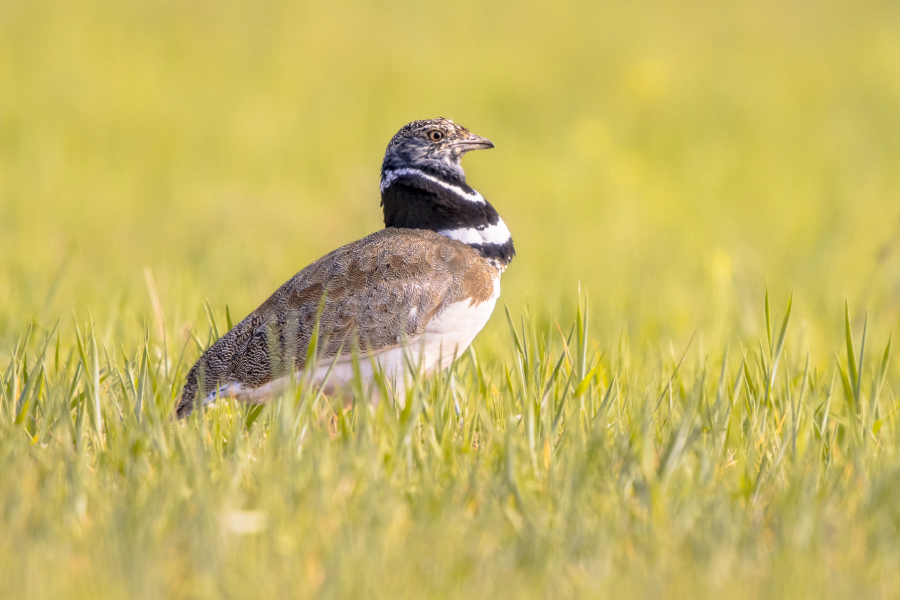
The little bustard is a steppe species classified as ‘Critically Endangered’ in Portugal. Photo: DR.
The 25 km² grid in question was surveyed by biologists Pedro Horta and Helena Raposeira from the Palombar research group. Within this area, all sites with steppe habitats were selected. At the time of preparing the study, there were around 3.5 km² of potential areas – of which 35% had recently been converted to permanent crops – leaving just 2.27 km² of available habitat across the entire area.
The survey was carried out by Palombar biologists Helena Raposeira and Pedro Horta. Photo: Pedro Horta/Palombar.
Only one individual recorded in the surveyed area
The survey results are in line with the trend observed by the other teams in the field: only a single individual was detected, outside the grid and the sampling periods.
The profound changes in land use – with the replacement of cereal crops by intensive and super-intensive olive and almond groves – combined with the increased use of pesticides, the levelling of watercourses, the installation of power lines and the constant movement of heavy machinery, place dramatic pressures on steppe species.
These impacts compromise not only biodiversity but also local ecosystem services, affecting soil and water quality, climate regulation and, consequently, the health and well-being of human populations.
The replacement of cereal crops with other intensive and super-intensive crops drastically reduces the habitat available to this species, which is at risk of disappearing. Photo: Pedro Horta/Palombar.
The little bustard: a species facing (almost) certain extinction in a region losing its identity
The foreseeable extinction of the little bustard in Portugal, highlighted by the results of this national census, represents more than just the loss of a species. It is a critical symptom of the agonising state of the Alentejo’s natural and semi-natural ecosystems – and also of the loss of a collective memory, of an ancestral relationship with the land, and of a way of life that has shaped this unique landscape.
When the stone curlews fall silent at dusk, the great bustards cease to strut across the plains, the harriers stop soaring over the cornfields, the cattle egrets cease to follow the cattle, and the little bustards disappear forever, the Alentejo will cease to be the Alentejo, in a foretold biosocial death.