


23 January 2026
SerE+: project kicks off in Serra da Estrela to bring science and communities together in restoring and enhancing nature services
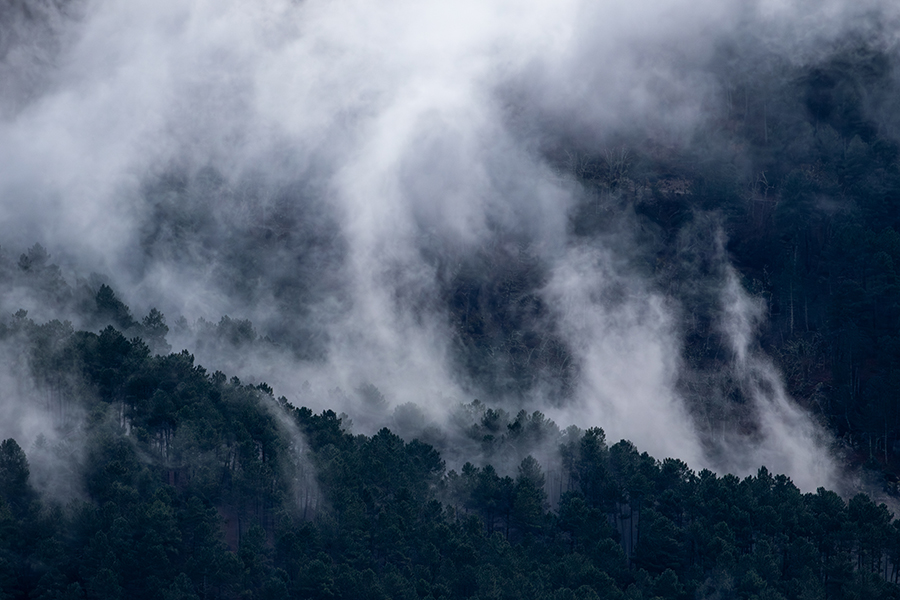
Fog wraps around the forest, revealing the serene and humid beauty of the high-altitude landscapes of Serra da Estrela. Photo: Pedro Alves/Palombar.
Partner meeting: consolidating strategy and methodologies
On 14 January, the project partners met at CISE for an intensive working day to consolidate the strategy to be followed and the methodologies to be applied. Representatives of the consortium responsible for implementing SerE+ were present: Palombar (coordinating entity); the Municipality of Seia, represented by CISE; the Centre for Ecology, Evolution and Environmental Change of the Faculty of Sciences of the University of Lisbon (CE3C) and the Spanish State Agency Consejo Superior de Investigaciones Científicas M.P. (CSIC), represented by the Doñana Biological Station.
This technical meeting, reserved for partners, aimed to consolidate the methodological strategy that will guide the early stages of the project. The focus was on sharing information and insights on the criteria for prioritising areas to be selected, defining the baseline for quantifying ecological restoration potential, and methods for mapping Ecosystem Services (ES), including the definition of socio-economic and environmental variables to be considered. The integration of quantitative Ecosystem Services maps into spatial prioritisation models will enable the identification of the future network of Ecosystem Services Acceleration Areas (AASE).
The final result of this work will be a practical and public tool: an open-access GIS web platform with robust scientific data, which will be available to the public, those responsible for land management and planning, and policy makers at regional, national and Iberian level.
Mapping and community consultation: project organises collaborative workshops
One of the most challenging aspects of the strategy outlined is the collaborative process of building all this knowledge. To ensure that the maps reflect the reality of the territory and the knowledge and perceptions of its communities, SerE+ will organise three collaborative workshops between March and June 2026.
These sessions will bring together citizens whose personal, professional, social and/or economic lives are intrinsically linked to the mountain landscape. Their knowledge will be fundamental in adjusting the models to the Serra da Estrela region, creating a tool that is both scientifically and socially relevant, valuing the community's perceptions of ecosystem services, specifically in the context of their lives and professional activities.
.jpg)
Partners in the SerE+ consortium worked together at the Serra da Estrela Interpretation Centre to consolidate the project strategy. Photo: Pedro Alves/Palombar.
Sharing expectations and promoting targeted partnerships
After a fruitful morning of debate and theoretical immersion, the partners had the opportunity to focus on the territory, heading to São Romão, Seia, for lunch surrounded by its green mountains, at the Sanctuary of Nossa Senhora do Desterro, next to the pilot area where the project plans to develop a set of environmental restoration actions. In a restaurant carved out of the granite rock of Estrela itself, the sharing of experiences and expectations had a strong impact on strengthening the team's commitment to actively cooperate in the conservation of the natural, social and economic heritage of Serra da Estrela.
Serra da Estrela, with its unique natural wealth, is a territory under immense pressure. The combination of climate change, devastating fires, severe droughts and declining snowfall is rapidly threatening the balance of ecosystems. Rural abandonment, the spread of invasive species, the construction of large infrastructure and the impact of unregulated tourism further aggravate the region's vulnerability and compromise the fragile balance of the mountain ecosystems, their biodiversity and the essential services they provide for the subsistence of the communities in this territory, the well-being and health of the populations and the regional economy.
It was precisely this urgency that echoed in the afternoon's discussions, reinforcing the conviction that SerE+ is a science-based response that relies on local participation to build a more resilient mountain range and an alternative path to progress that places nature conservation alongside regional development, based on principles of sustainability.
.jpg)
Abundant watercourses meander through the mountain slopes, a vital ecosystem service that depends on ice and snow formation to persist during the driest months. Photo: Pedro Alves/Palombar.
When science puts on its boots and explores the region
The afternoon of the 14th was dedicated to connecting with the territory. The partners travelled to Mata do Desterro, a riverside forest that runs along the rugged banks of the Alva River. On these slopes, the fragilities of the territory were identified, which will be the focus of the SerE+ project pilot trial, and planning began for the actions that will be carried out to redevelop the area.
The SerE+ project will create a living laboratory where, over the next three years, ecological restoration actions will be implemented, such as planting native vegetation, the control of invasive species using a variety of techniques, the clearing of scrub and seedbeds, the restoration of water points, the creation of a fish ladder, the microbiological inoculation of soils and the installation of wildlife shelters.
It is also in Mata do Desterro, which borders the Natural Electricity Museum, that a themed walking trail on Ecosystem Services will be established, taking advantage of an existing trail to integrate it into the project's themes. This interpretive trail will be inaugurated at a public event at the end of the project in 2028, with the mission of encouraging the community and visitors to immerse themselves in exploring the value of nature, which too often goes unnoticed.
.jpg)
In Mata do Desterro, which runs along the right bank of the Alva River, there is already a small walking trail that highlights the natural beauty of the landscape. One of the actions of the SerE+ project consists of implementing a new walking trail, exclusively dedicated to understanding the ecosystem services provided by Serra da Estrela. Photo: Pedro Alves/Palombar.
Public presentation of the SerE+ project: event brought together around 90 people from various sectors
On 15 January, CISE hosted the public launch event for the SerE+ project. The session was very well attended and involved around 90 people from various sectors and fields, including the local population, representatives of civil society, non-governmental organisations, local authorities, government entities such as the Institute for Nature Conservation and Forests (ICNF), universities, companies and associations from the forestry and certification sector, among other interested local actors and the general public. Through various panels, the different partners presented the objectives, methodology and path to be followed, promoting an open conversation about future initiatives and inviting civic participation in the construction of the project.
.jpg)
Pedro Horta, project coordinator and research and conservation technician at Palombar, presented SerE+'s vision and objectives for the next three years of work. Photo: Pedro Alves/Palombar.
The programme reflected the intention to communicate the project's objectives and actions transparently, evolving from a general presentation to an in-depth thematic exploration. After the opening, the presentation of the project by Pedro Horta, research and conservation technician at Palombar and coordinator of SerE+, established the framework and collective ambition.
This was followed by presentations by researcher Virgílio Hermoso, from the Doñana Biological Station, Agencia Estatal Consejo Superior de Investigaciones Científicas M.P., and professor and researcher Hugo Rebelo, from the Centre for Ecology, Evolution and Environmental Change (CE3C) at the Faculty of Sciences of the University of Lisbon, who detailed the approaches that will be applied in mapping and prioritising the AASE network.
The second part of the presentations focused on the reality and natural value of Serra da Estrela, connecting science to the territory. José Conde, senior technician at CISE, addressed the critical and sensitive issue of water resources, while Alexandre Silva, forestry engineer at CISE, highlighted the richness and particularities of the unique flora of the highest mountain in mainland Portugal, as well as its benefits for communities, for example through the application of compounds in pharmaceuticals.
Finally, José Pereira, president of Palombar, recalled the association's history of environmental restoration linked to the preservation of territorial identity.
.jpg)
Pedro Horta (Palombar), José Conde (CISE), Hugo Rebelo (CE3C) and Virgílio Hermoso (not visible in the image), during the presentations at the launch event. Photo: Pedro Alves/Palombar.
“Our guiding principle is to understand what makes sense for both nature and the local population.”
- Pedro Horta, research and conservation technician at Palombar and coordinator of the SerE+ project
“CISE, as a service provided by the Municipality of Seia, will play an essential role in connecting the project's scientific team with the local community."
- José Conde, senior technician at CISE
“The co-creative processes that allow us to use scientific knowledge to improve biodiversity and the local socio-economic fabric are a tremendous opportunity that we have in this project.”
- Hugo Rebelo, professor and researcher at the Centre for Ecology, Evolution and Environmental Change (CE3C) of the Faculty of Sciences of the University of Lisbon
“The project aims to help identify priority areas for restoring habitats that support biodiversity conservation and the enhancement of ecosystem services.”
- Virgílio Hermoso, researcher at the Doñana Biological Station, Agencia Estatal Consejo Superior de Investigaciones Científicas M.P. (CSIC)
.jpg)
The audience interacted with the speakers, in a crucial moment of sharing between the project partners and various agents promoting the Serra da Estrela landscape. Photo: Pedro Alves/Palombar.
The launch event for the SerE+ project marked the beginning of a journey undertaken by science and the community side by side, transforming scientific and local knowledge into practical tools for territorial management.
The project's mission is to contribute to environmental conservation and restoration, enhancing the social and regenerative value of the region. The vision that guides us is the search for landscape resilience capable of honouring the natural and social heritage of Serra da Estrela and its future generations.
.jpg)
The CISE auditorium was packed, reflecting the community's strong interest and curiosity in the launch of the SerE+ project. Photo: Pedro Alves/Palombar.
About the project
The SerE+ project - Network of Ecosystem Service Acceleration Areas in Serra da Estrela seeks to create integrative and locally adapted tools capable of supporting the restoration and conservation of ecosystem services in the mountain region, identifying the locations with the greatest potential for conservation and enhancement of these services, promoting balance with socio-economic activities and proposing concrete conservation and restoration measures for the territory.
It is coordinated by Palombar and developed in partnership with the Centre for Ecology, Evolution and Environmental Change (CE3C) of the Faculty of Sciences of the University of Lisbon, the Municipality of Seia, through the Serra da Estrela Interpretation Centre (CISE), and the State Agency Consejo Superior de Investigaciones Científicas M.P., through the Doñana Biological Station in Spain.
With a duration of three years, SerE+ is supported by the Promove Programme of the “la Caixa” Foundation, in collaboration with BPI and the Foundation for Science and Technology (FCT). Its intervention covers the total area of the six municipalities that make up the Serra da Estrela Natural Park.