


8 August 2024
LIFE Aegypius Return: 35 Cinereous Vulture chicks already tagged
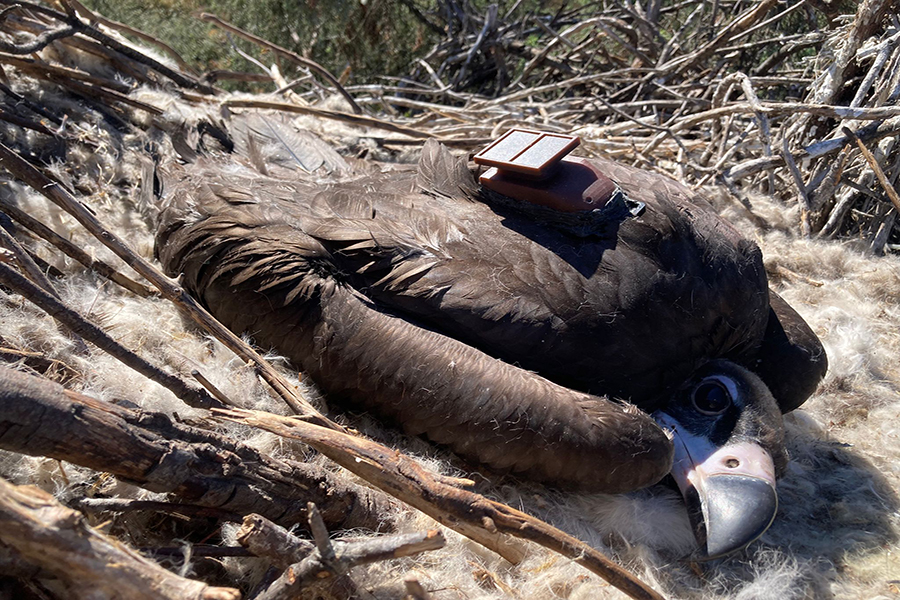
Cinereous Vulture chick with a GPS/GSM transmitter, after being returned to the nest. Photo credit Palombar.
The "tagging season" for Cinereous Vulture (Aegypius monachus) chicks ended at the beginning of August. In 2024, the LIFE Aegypius Return project tagged 20 Cinereous Vulture chicks in the nest, in addition to the 15 tagged in 2023.
A year full of news
The LIFE Aegypius Return project had planned to tag 30 chicks in the nest: 15 in 2023 and another 15 in 2024. However, the positive results that the species has shown have changed these plans.
The project team distributes the taggings - and the available equipment - through the species' various breeding colonies in Portugal. The four previously known colonies have shown signs of expansion, and a fifth colony has been confirmed, strengthening hope for the species' recovery in Portugal.
Douro Internacional, the most isolated colony
The Douro International breeding colony is the most isolated in the country, situated more than 100 kilometres from the nearest colony in Spain. This isolation, coupled with its small number of breeding pairs, makes it highly vulnerable, as any random event, such as a forest fire, could have devastating and difficult-to-reverse consequences. The colony was established in 2012 with a nesting pair that failed to breed at that time. The number of pairs only increased to two in 2019 and to three in 2023, so it was with surprise that eight breeding pairs were registered this year: five on the Portuguese side and three on the Spanish side. Three of the hatchlings were tagged, one of them in the Arribes del Duero Natural Park in Spain.
Taggings on the cliffs are particularly challenging due to the difficulty in accessing the nests, and require the collaboration of various specialists, including professional climbers.
These taggings were possible thanks to a cross-border collaboration involving Palombar, the Arribes del Duero Natural Park; the Junta de Castilla y León; the Dirección General de Emergencias - Cuerpo de Agentes Forestales de la Comunidad de Madrid; the Universidad de Oviedo; the Liga para a Protecção da Natureza (LPN); the Classified Areas and Nature Watch Division of the Institute for Nature Conservation and Forests (ICNF) - Northern Regional Directorate for Nature Conservation and Forests; the veterinary team from the Wild Animal Recovery Centre at the Veterinary Hospital of the University of Trás-os-Montes and Alto Douro; and Javier de la Puente, a bird conservation specialist and Palombar’s collaborator.
Malcata, a remarkable expansion
The Serra da Malcata colony was established in 2021, with four known breeding pairs. In 2023 the colony increased to an impressive number of 14 breeding pairs, and in 2024 the figure continued to rise, to 19. This led the team to double the number of birds tagged this year to six.
The challenge of these taggings is accessing the nests and the height of the trees on which they are built.
The tagging team at the Serra da Malcata Nature Reserve had the indispensable collaboration of Carlos Pacheco, Associação Transumância e Natureza/Faia Brava (ATN), Rewilding Portugal, ICNF - Centre Regional Delegation, LPN and the Vulture Conservation Foundation (VCF).
Tejo Internacional, the largest colony in Portugal
The establishment of the Tejo Internacional breeding colony in 2010 represented the official recolonisation of Portugal by the Cinereous Vulture, after around 40 years of absence as a breeding species. Since then, this colony has been closely monitored and, by 2023, it was home to more than half of the country's breeding population. This year, the number of nesting pairs increased to around 60, and it was possible to tag seven chicks. Of these, one is of known lineage! Aravil's son was tagged, one of the offspring of the colony's two founding pairs in 2010.
These taggings were made possible thanks to the collaboration of the Portuguese Society for the Study of Birds (SPEA), Quercus and the Centre for the Study and Recovery of Wild Animals (CERAS), the LPN, the ICNF - Centre Regional Delegation, the VCF, the da Guarda Nacional Republicana (GNR - Idanha-a-Nova Environmental Protection Centre, Castelo Branco District Command) and the biologist Alfonso Godino, and were supported by Hawk Mountain Sanctuary and ENDESA.
Herdade da Contenda, the colony that expands eastwards
This breeding colony was established with two nesting pairs in 2015, following the conservation efforts of the LIFE Habitat Lince Abutre project, led by the LPN. Since then, it has gradually grown and this year it has recorded at least 20 breeding pairs - five of which established in Spanish territory, three more than last year. Although ecologically all these birds belong to the same colony, from an administrative and conservation point of view, this apparent expansion brings some additional safety measures under a cross-border collaboration.
In July, three chicks were tagged at Herdade da Contenda, thanks to the collaboration of LPN, Herdade da Contenda, e.m., ICNF - Alentejo Regional Delegation, VCF, ATN and Carlos Pacheco. The work was also attended by representatives of Moura City Council, which owns the Herdade da Contenda estate.
The fifth and most recent breeding colony, in Vidigueira
This breeding colony, discovered in June by the ICNF in Vidigueira (Southern Portugal), is the most recent and the smallest in the country. It is also the westernmost known colony in the species' global distribution area.
Four Cinereous Vulture nests were detected, but only one with a breeding pair, whose chick weas promptly tagged by a team made up of members of the ICNF - Alentejo Regional Delegation, the LPN and the tagger, Carlos Pacheco.
Tagging Cinereous Vultures to reduce their mortality rate
Tagging is a complex process that requires the participation of accredited specialists from various fields: biologists, veterinarians, authorities, climbers... The birds are subjected to a veterinary examination and biological samples are taken that will allow to understand the vulture’s health condition and establish reference values for the species – information that is of great relevance to the veterinary teams and recovery centres that treat Cinereous Vultures. They are then marked with a metal ring with a unique identification code, a coloured ring that allows the bird to be identified from a distance, and a GPS/GSM transmitter, which is continuously monitored.
The device, which weighs only around 50 grams, enables the monitoring of the bird’s movements and behaviour. Any anomalies can be quickly detected, a team can go to the bird and, if necessary, take it to a wildlife recovery centre. This swift action makes it possible to rescue and care for vultures that would otherwise probably die in the field. For an endangered species with a relatively small population, the survival of each individual is crucial for the species' recovery.
In total, the LIFE Aegypius Return project plans to tag 60 Cinereous Vultures. In addition to tagging chicks in the nest, the project includes attempting to capture adults, such as Aravil, and the soft release of rehabilitated juveniles after their acclimatisation in Douro International.
The LIFE Aegypius Return partners would like to thank all the people and organisations that have collaborated in monitoring and tagging in the five colonies.
The project teams will continue to monitor the chicks until they leave the nest and become fully independent, which should happen by late August or early September. At that point, it will also be possible to finalise and disclose the full results of this breeding season. Follow our project website or the partners' social networks.
A year full of news
The LIFE Aegypius Return project had planned to tag 30 chicks in the nest: 15 in 2023 and another 15 in 2024. However, the positive results that the species has shown have changed these plans.
The project team distributes the taggings - and the available equipment - through the species' various breeding colonies in Portugal. The four previously known colonies have shown signs of expansion, and a fifth colony has been confirmed, strengthening hope for the species' recovery in Portugal.
Douro Internacional, the most isolated colony
The Douro International breeding colony is the most isolated in the country, situated more than 100 kilometres from the nearest colony in Spain. This isolation, coupled with its small number of breeding pairs, makes it highly vulnerable, as any random event, such as a forest fire, could have devastating and difficult-to-reverse consequences. The colony was established in 2012 with a nesting pair that failed to breed at that time. The number of pairs only increased to two in 2019 and to three in 2023, so it was with surprise that eight breeding pairs were registered this year: five on the Portuguese side and three on the Spanish side. Three of the hatchlings were tagged, one of them in the Arribes del Duero Natural Park in Spain.
Taggings on the cliffs are particularly challenging due to the difficulty in accessing the nests, and require the collaboration of various specialists, including professional climbers.
These taggings were possible thanks to a cross-border collaboration involving Palombar, the Arribes del Duero Natural Park; the Junta de Castilla y León; the Dirección General de Emergencias - Cuerpo de Agentes Forestales de la Comunidad de Madrid; the Universidad de Oviedo; the Liga para a Protecção da Natureza (LPN); the Classified Areas and Nature Watch Division of the Institute for Nature Conservation and Forests (ICNF) - Northern Regional Directorate for Nature Conservation and Forests; the veterinary team from the Wild Animal Recovery Centre at the Veterinary Hospital of the University of Trás-os-Montes and Alto Douro; and Javier de la Puente, a bird conservation specialist and Palombar’s collaborator.
Malcata, a remarkable expansion
The Serra da Malcata colony was established in 2021, with four known breeding pairs. In 2023 the colony increased to an impressive number of 14 breeding pairs, and in 2024 the figure continued to rise, to 19. This led the team to double the number of birds tagged this year to six.
The challenge of these taggings is accessing the nests and the height of the trees on which they are built.
The tagging team at the Serra da Malcata Nature Reserve had the indispensable collaboration of Carlos Pacheco, Associação Transumância e Natureza/Faia Brava (ATN), Rewilding Portugal, ICNF - Centre Regional Delegation, LPN and the Vulture Conservation Foundation (VCF).
Tejo Internacional, the largest colony in Portugal
The establishment of the Tejo Internacional breeding colony in 2010 represented the official recolonisation of Portugal by the Cinereous Vulture, after around 40 years of absence as a breeding species. Since then, this colony has been closely monitored and, by 2023, it was home to more than half of the country's breeding population. This year, the number of nesting pairs increased to around 60, and it was possible to tag seven chicks. Of these, one is of known lineage! Aravil's son was tagged, one of the offspring of the colony's two founding pairs in 2010.
These taggings were made possible thanks to the collaboration of the Portuguese Society for the Study of Birds (SPEA), Quercus and the Centre for the Study and Recovery of Wild Animals (CERAS), the LPN, the ICNF - Centre Regional Delegation, the VCF, the da Guarda Nacional Republicana (GNR - Idanha-a-Nova Environmental Protection Centre, Castelo Branco District Command) and the biologist Alfonso Godino, and were supported by Hawk Mountain Sanctuary and ENDESA.
Herdade da Contenda, the colony that expands eastwards
This breeding colony was established with two nesting pairs in 2015, following the conservation efforts of the LIFE Habitat Lince Abutre project, led by the LPN. Since then, it has gradually grown and this year it has recorded at least 20 breeding pairs - five of which established in Spanish territory, three more than last year. Although ecologically all these birds belong to the same colony, from an administrative and conservation point of view, this apparent expansion brings some additional safety measures under a cross-border collaboration.
In July, three chicks were tagged at Herdade da Contenda, thanks to the collaboration of LPN, Herdade da Contenda, e.m., ICNF - Alentejo Regional Delegation, VCF, ATN and Carlos Pacheco. The work was also attended by representatives of Moura City Council, which owns the Herdade da Contenda estate.
The fifth and most recent breeding colony, in Vidigueira
This breeding colony, discovered in June by the ICNF in Vidigueira (Southern Portugal), is the most recent and the smallest in the country. It is also the westernmost known colony in the species' global distribution area.
Four Cinereous Vulture nests were detected, but only one with a breeding pair, whose chick weas promptly tagged by a team made up of members of the ICNF - Alentejo Regional Delegation, the LPN and the tagger, Carlos Pacheco.
Tagging Cinereous Vultures to reduce their mortality rate
Tagging is a complex process that requires the participation of accredited specialists from various fields: biologists, veterinarians, authorities, climbers... The birds are subjected to a veterinary examination and biological samples are taken that will allow to understand the vulture’s health condition and establish reference values for the species – information that is of great relevance to the veterinary teams and recovery centres that treat Cinereous Vultures. They are then marked with a metal ring with a unique identification code, a coloured ring that allows the bird to be identified from a distance, and a GPS/GSM transmitter, which is continuously monitored.
The device, which weighs only around 50 grams, enables the monitoring of the bird’s movements and behaviour. Any anomalies can be quickly detected, a team can go to the bird and, if necessary, take it to a wildlife recovery centre. This swift action makes it possible to rescue and care for vultures that would otherwise probably die in the field. For an endangered species with a relatively small population, the survival of each individual is crucial for the species' recovery.
In total, the LIFE Aegypius Return project plans to tag 60 Cinereous Vultures. In addition to tagging chicks in the nest, the project includes attempting to capture adults, such as Aravil, and the soft release of rehabilitated juveniles after their acclimatisation in Douro International.
The LIFE Aegypius Return partners would like to thank all the people and organisations that have collaborated in monitoring and tagging in the five colonies.
The project teams will continue to monitor the chicks until they leave the nest and become fully independent, which should happen by late August or early September. At that point, it will also be possible to finalise and disclose the full results of this breeding season. Follow our project website or the partners' social networks.