


24 August 2026
LIFE Aegypius Return has tagged 13 Cinereous vulture chicks with GPS trackers this year to monitor the new generation
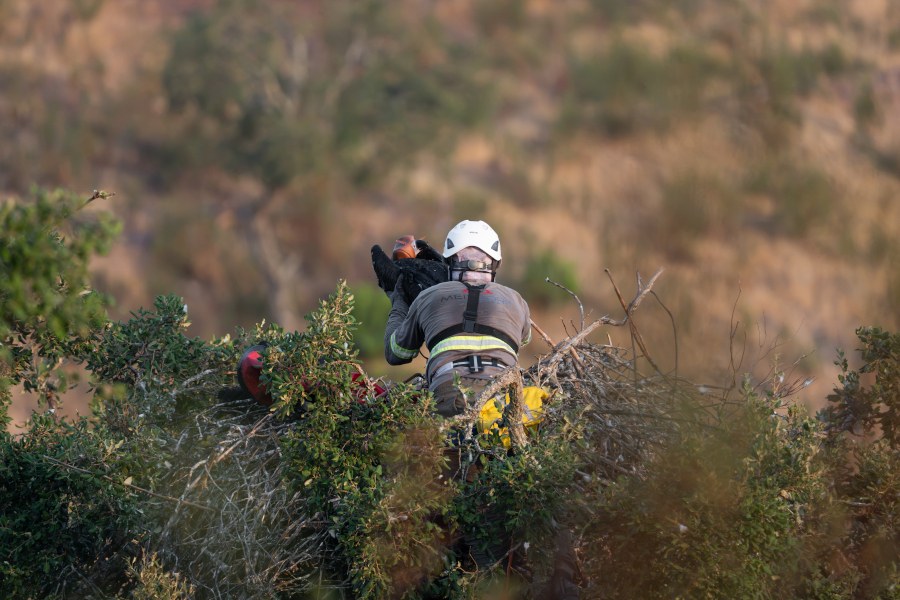
Capture of Cinereous vulture chick. Photo: Miguel Pires.
Thanks to another major collaborative effort, the LIFE Aegypius Return project has successfully completed the 2026 tagging season. This year, 13 new Cinereous vultures (Aegypius monachus) chicks have been added to the project’s monitoring programme.
The final stages of each breeding season also mark the start of an important task: the ‘tagging season’. This year, field teams in Portugal visited the Cinereous vulture breeding colonies in the Douro Internacional, Tejo Internacional, Herdade da Contenda (on both sides of the border, in Portugal and Spain) and Vidigueira/Portel. The 13 birds ringed in 2026 are being added to the 43 chicks ringed between 2023 and 2025, bringing the total to 56 chicks monitored as part of the project.
The multidisciplinary logistics behind the scenes
All the fieldwork involved in monitoring, tagging (fitting GPS/GSM transmitters), ringing and collecting samples from Cinereous vulture chicks requires far more preparation than meets the eye. In addition to the multidisciplinary teams involved – which include colony monitors, accredited ringers and taggers, vets, biologists and experts in working at height – there is a great deal of planning and coordination taking place behind the scenes.
In the months leading up to the tagging season, local teams devote countless hours to locating breeding pairs, identifying active nests and monitoring the chicks’ development. This work enables them to estimate the age of each chick, plan field operations and, later on, assess breeding success. Ideally, Cinereous vulture chicks are tagged when they are between 80 and 90 days old, a stage at which they are sufficiently developed to safely receive a GPS/GSM transmitter.
The 2026 breeding season was characterised by particularly challenging conditions, including early heatwaves that affected mainland Portugal during July. In this context, the continuous monitoring of breeding colonies proved to be particularly important, enabling the teams to choose the most appropriate times to access the nests, minimise disturbance to the birds and ensure the safety and welfare of both the chicks and the adults.
GPS: information that helps to save, protect and conserve
These annual tagging exercises, and the valuable information gathered through them, have played a key role in the success of the LIFE Aegypius Return project over recent years. By fitting Cinereous vulture chicks with GPS/GSM transmitters, the project team is able to track their movements during their first few years of life. This monitoring provides a better understanding of where they travel, where they find food, where they rest and roost, enables the identification of chicks in danger, and reveals many other aspects of their behaviour.
Every recorded movement adds a new piece to the puzzle, allowing for a more detailed understanding of how young vultures explore the landscape, use the territory and interact with other colonies.
.jpg)
.jpg)
However, the value of this information extends far beyond simply understanding the species. The data collected is an essential tool for tackling current conservation challenges, supporting the development of more effective strategies and informing management decisions at national level.
One of the most recent examples of how this monitoring work supports conservation is its contribution to the assessment of renewable energy projects in Portugal, one of the key challenges of the LIFE Aegypius Return project in 2026.
Using GPS data, it has been possible to identify the areas most frequently used and most relevant to the Cinereous vulture. This information has served as the basis for the preparation of technical opinions underpinned by scientific evidence, helping to minimise potential impacts on the species and promoting a balanced approach between the energy transition and biodiversity conservation.
Beyond movement tracking: the study of biological samples
Fieldwork also provides the project with a unique opportunity to deepen our understanding of the Cinereous vulture at the population level. During tagging operations, whilst the chicks are carefully removed from their nests to have GPS transmitters fitted, the team takes the opportunity to collect a range of biological samples for scientific purposes.
As part of the LIFE Aegypius Return project, a protocol for collecting biological samples was developed in collaboration with researchers and institutions from various scientific fields. This work has paved the way for several lines of research of great interest to the population health and conservation of the species.
Samples such as blood, feathers and swabs are collected and sent to specialist research centres, where their analysis helps to answer a number of fundamental questions relating to this species. Scientific teams have been studying the presence of environmental contaminants in the population, the genetic origin of Portuguese birds, and establishing reference values for blood and biochemical parameters. Other research also focuses on the bacteria present in the vultures’ oral and cloacal cavities, as well as on the internal and external parasites found within the colonies.
.jpg)
Taken together, these studies provide important information on the origin and general health of the Portuguese population, contributing to a better understanding of its main needs and threats.
All chicks are also fitted with a metal ring and a coloured PVC ring on their legs. These rings allow each individual to be identified throughout its entire life, making it possible to track its movements. Whenever a ringed bird is observed – whether by birdwatchers, via camera traps or at feeding sites for scavenger birds – it is possible to trace its history, including where it was born.
.jpg)
The people who make it happen
All this progress would be impossible without the commitment and dedication of the project’s partners and collaborators, whose work takes place both in the field and behind the scenes. As the LIFE Aegypius Return project enters its final year of implementation, the number of people involved in initiatives such as this reflects the collective commitment to the conservation of the Cinereous vulture and to building a promising future for the species.
.jpeg)
The 2026 tagging season was made possible thanks to the support and participation of the following organisations and volunteers at the respective tagging sites:
Douro Internacional: Palombar; Biodiversity Research Institute (IMIB, CSIC-Universidad de Oviedo-Principado de Asturias); ICNF – Direção Regional do Norte; Junta de Castilla y León; Arribes del Duero Natural Park; Liga para a Protecção da Natureza (LPN); the veterinary team from CRAS HV-UTAD (University of Trás-os-Montes e Alto Douro); Jade Gava; Vulture Conservation Foundation (VCF).
Tejo Internacional: Sociedade Portuguesa para o Estudo das Aves (SPEA); Liga para a Protecção da Natureza (LPN); ICNF; Guarda Nacional Republicana (GNR); Centro de Estudos e Recuperação de Animais Selvagens (CERAS); Alfonso Godino; Samuel Infante; Carlos Pacheco; Vulture Conservation Foundation (VCF).
Vidigueira/Portel: Liga para a Protecção da Natureza (LPN); Herdade do Monte da Ribeira – Eng.ª Mariana Carmona and António Aleixo; ICNF – Direção Regional de Conservação da Natureza e Florestas do Alentejo; Jade Gava; Carlos Pacheco; Timóteo Mendes; Vulture Conservation Foundation (VCF).
Herdade da Contenda
Portugal: Liga para a Protecção da Natureza (LPN); Herdade da Contenda; Guarda Nacional Republicana (GNR); ICNF – Direção Regional de Conservação da Natureza e Florestas do Alentejo; Carlos Pacheco; Timóteo Mendes; José Figueira; Maria Rossas, Carlos Cruz, Nuno Calça (CARAS – Centro de Acolhimento e Recuperação de Animais Silvestres, Évora); Junta de Freguesia de Santo Aleixo da Restauração; Vulture Conservation Foundation (VCF).
Sierra Pelada, Spain: Liga para a Protecção da Natureza (LPN); Junta de Andalucía; Carlos Pacheco; Timóteo Mendes; Maria Rossas; Vulture Conservation Foundation (VCF).
About the project
The LIFE Aegypius Return project is co-funded by the European Union’s LIFE programme. Its success depends on the involvement of all relevant stakeholders and the collaboration of the partners: the Vulture Conservation Foundation (VCF), the coordinating beneficiary, and the local partners Palombar – Nature and Rural Heritage Conservation, Herdade da Contenda, the Portuguese Society for the Study of Birds, the League for the Protection of Nature, Faia Brava – Nature Conservation Association, Fundación Naturaleza y Hombre, the National Republican Guard and the National Association of Rural Landowners for Game Management and Biodiversity.
The final stages of each breeding season also mark the start of an important task: the ‘tagging season’. This year, field teams in Portugal visited the Cinereous vulture breeding colonies in the Douro Internacional, Tejo Internacional, Herdade da Contenda (on both sides of the border, in Portugal and Spain) and Vidigueira/Portel. The 13 birds ringed in 2026 are being added to the 43 chicks ringed between 2023 and 2025, bringing the total to 56 chicks monitored as part of the project.
The multidisciplinary logistics behind the scenes
All the fieldwork involved in monitoring, tagging (fitting GPS/GSM transmitters), ringing and collecting samples from Cinereous vulture chicks requires far more preparation than meets the eye. In addition to the multidisciplinary teams involved – which include colony monitors, accredited ringers and taggers, vets, biologists and experts in working at height – there is a great deal of planning and coordination taking place behind the scenes.
In the months leading up to the tagging season, local teams devote countless hours to locating breeding pairs, identifying active nests and monitoring the chicks’ development. This work enables them to estimate the age of each chick, plan field operations and, later on, assess breeding success. Ideally, Cinereous vulture chicks are tagged when they are between 80 and 90 days old, a stage at which they are sufficiently developed to safely receive a GPS/GSM transmitter.
The 2026 breeding season was characterised by particularly challenging conditions, including early heatwaves that affected mainland Portugal during July. In this context, the continuous monitoring of breeding colonies proved to be particularly important, enabling the teams to choose the most appropriate times to access the nests, minimise disturbance to the birds and ensure the safety and welfare of both the chicks and the adults.
GPS: information that helps to save, protect and conserve
These annual tagging exercises, and the valuable information gathered through them, have played a key role in the success of the LIFE Aegypius Return project over recent years. By fitting Cinereous vulture chicks with GPS/GSM transmitters, the project team is able to track their movements during their first few years of life. This monitoring provides a better understanding of where they travel, where they find food, where they rest and roost, enables the identification of chicks in danger, and reveals many other aspects of their behaviour.
Every recorded movement adds a new piece to the puzzle, allowing for a more detailed understanding of how young vultures explore the landscape, use the territory and interact with other colonies.
Fitting a GPS/GSM transmitter to a Cinereous vulture (Aegypius monachus) chick. Photo: Miguel Pires.
A Cinereous vulture chick returned to its nest after being fitted with a GPS/GSM transmitter. Photo: Palombar.
However, the value of this information extends far beyond simply understanding the species. The data collected is an essential tool for tackling current conservation challenges, supporting the development of more effective strategies and informing management decisions at national level.
One of the most recent examples of how this monitoring work supports conservation is its contribution to the assessment of renewable energy projects in Portugal, one of the key challenges of the LIFE Aegypius Return project in 2026.
Using GPS data, it has been possible to identify the areas most frequently used and most relevant to the Cinereous vulture. This information has served as the basis for the preparation of technical opinions underpinned by scientific evidence, helping to minimise potential impacts on the species and promoting a balanced approach between the energy transition and biodiversity conservation.
Beyond movement tracking: the study of biological samples
Fieldwork also provides the project with a unique opportunity to deepen our understanding of the Cinereous vulture at the population level. During tagging operations, whilst the chicks are carefully removed from their nests to have GPS transmitters fitted, the team takes the opportunity to collect a range of biological samples for scientific purposes.
As part of the LIFE Aegypius Return project, a protocol for collecting biological samples was developed in collaboration with researchers and institutions from various scientific fields. This work has paved the way for several lines of research of great interest to the population health and conservation of the species.
Samples such as blood, feathers and swabs are collected and sent to specialist research centres, where their analysis helps to answer a number of fundamental questions relating to this species. Scientific teams have been studying the presence of environmental contaminants in the population, the genetic origin of Portuguese birds, and establishing reference values for blood and biochemical parameters. Other research also focuses on the bacteria present in the vultures’ oral and cloacal cavities, as well as on the internal and external parasites found within the colonies.
Collection of biological samples from a Cinereous vulture chick. Photo: Paulo Monteiro/SPEA.
Taken together, these studies provide important information on the origin and general health of the Portuguese population, contributing to a better understanding of its main needs and threats.
All chicks are also fitted with a metal ring and a coloured PVC ring on their legs. These rings allow each individual to be identified throughout its entire life, making it possible to track its movements. Whenever a ringed bird is observed – whether by birdwatchers, via camera traps or at feeding sites for scavenger birds – it is possible to trace its history, including where it was born.
Ringing a Cinereous vulture chick with a PVC ring. Photo: Miguel Pires.
The people who make it happen
All this progress would be impossible without the commitment and dedication of the project’s partners and collaborators, whose work takes place both in the field and behind the scenes. As the LIFE Aegypius Return project enters its final year of implementation, the number of people involved in initiatives such as this reflects the collective commitment to the conservation of the Cinereous vulture and to building a promising future for the species.
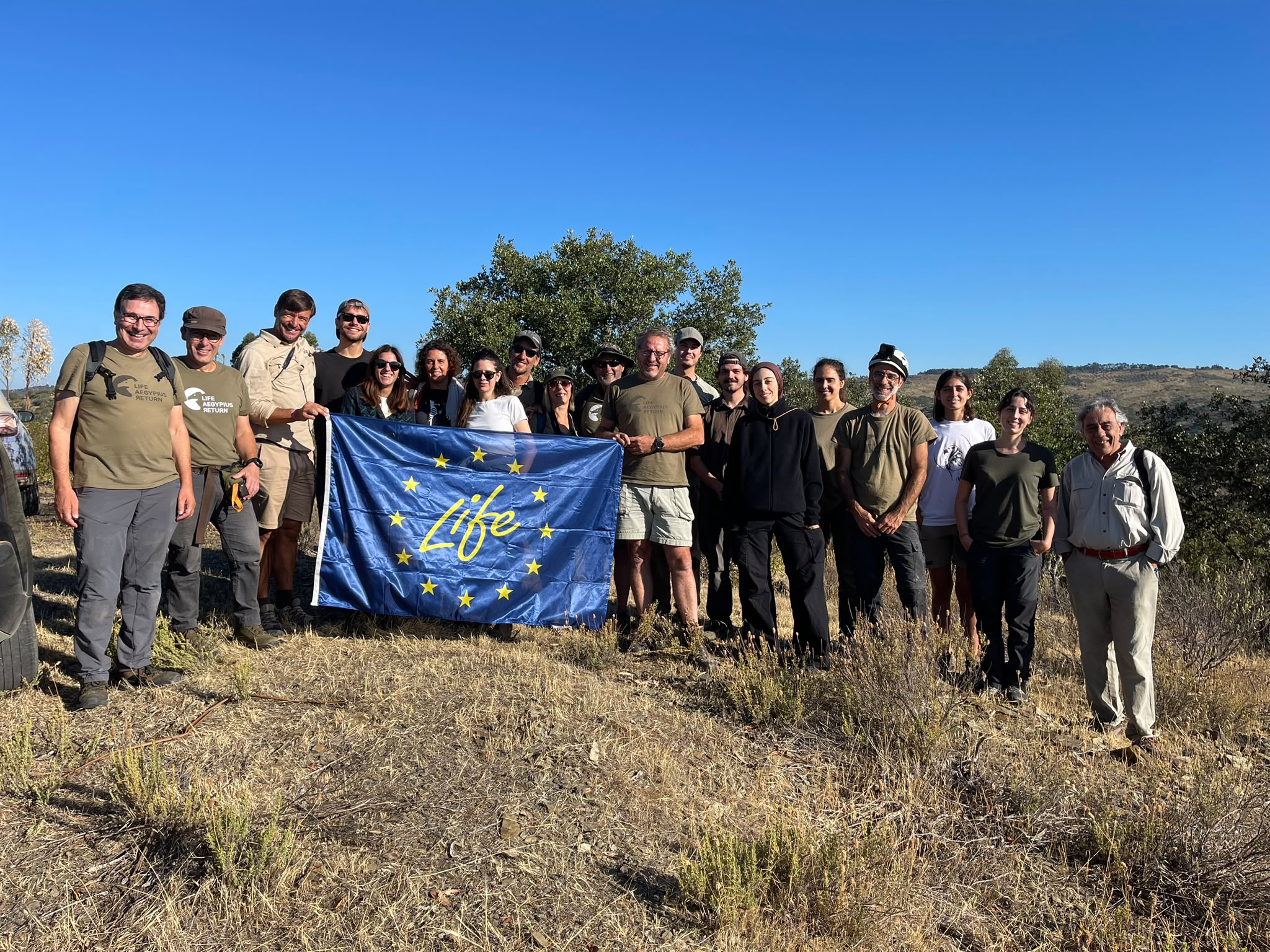
Project partners and volunteers during the tagging campaigns on the International Tagus. Photo: VCF.
Project partners and volunteers during the tagging campaigns in Vidigueira/Portel. Photo: VCF.
The 2026 tagging season was made possible thanks to the support and participation of the following organisations and volunteers at the respective tagging sites:
Douro Internacional: Palombar; Biodiversity Research Institute (IMIB, CSIC-Universidad de Oviedo-Principado de Asturias); ICNF – Direção Regional do Norte; Junta de Castilla y León; Arribes del Duero Natural Park; Liga para a Protecção da Natureza (LPN); the veterinary team from CRAS HV-UTAD (University of Trás-os-Montes e Alto Douro); Jade Gava; Vulture Conservation Foundation (VCF).
Tejo Internacional: Sociedade Portuguesa para o Estudo das Aves (SPEA); Liga para a Protecção da Natureza (LPN); ICNF; Guarda Nacional Republicana (GNR); Centro de Estudos e Recuperação de Animais Selvagens (CERAS); Alfonso Godino; Samuel Infante; Carlos Pacheco; Vulture Conservation Foundation (VCF).
Vidigueira/Portel: Liga para a Protecção da Natureza (LPN); Herdade do Monte da Ribeira – Eng.ª Mariana Carmona and António Aleixo; ICNF – Direção Regional de Conservação da Natureza e Florestas do Alentejo; Jade Gava; Carlos Pacheco; Timóteo Mendes; Vulture Conservation Foundation (VCF).
Herdade da Contenda
Portugal: Liga para a Protecção da Natureza (LPN); Herdade da Contenda; Guarda Nacional Republicana (GNR); ICNF – Direção Regional de Conservação da Natureza e Florestas do Alentejo; Carlos Pacheco; Timóteo Mendes; José Figueira; Maria Rossas, Carlos Cruz, Nuno Calça (CARAS – Centro de Acolhimento e Recuperação de Animais Silvestres, Évora); Junta de Freguesia de Santo Aleixo da Restauração; Vulture Conservation Foundation (VCF).
Sierra Pelada, Spain: Liga para a Protecção da Natureza (LPN); Junta de Andalucía; Carlos Pacheco; Timóteo Mendes; Maria Rossas; Vulture Conservation Foundation (VCF).
About the project
The LIFE Aegypius Return project is co-funded by the European Union’s LIFE programme. Its success depends on the involvement of all relevant stakeholders and the collaboration of the partners: the Vulture Conservation Foundation (VCF), the coordinating beneficiary, and the local partners Palombar – Nature and Rural Heritage Conservation, Herdade da Contenda, the Portuguese Society for the Study of Birds, the League for the Protection of Nature, Faia Brava – Nature Conservation Association, Fundación Naturaleza y Hombre, the National Republican Guard and the National Association of Rural Landowners for Game Management and Biodiversity.